Writer, Translator, Scholar, Internationalist
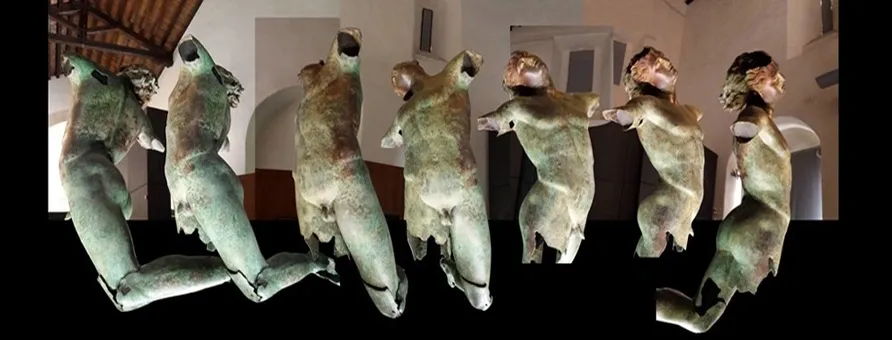
Bannerhead: The Dancing Satyr of Mazara del Vallo
RECENT
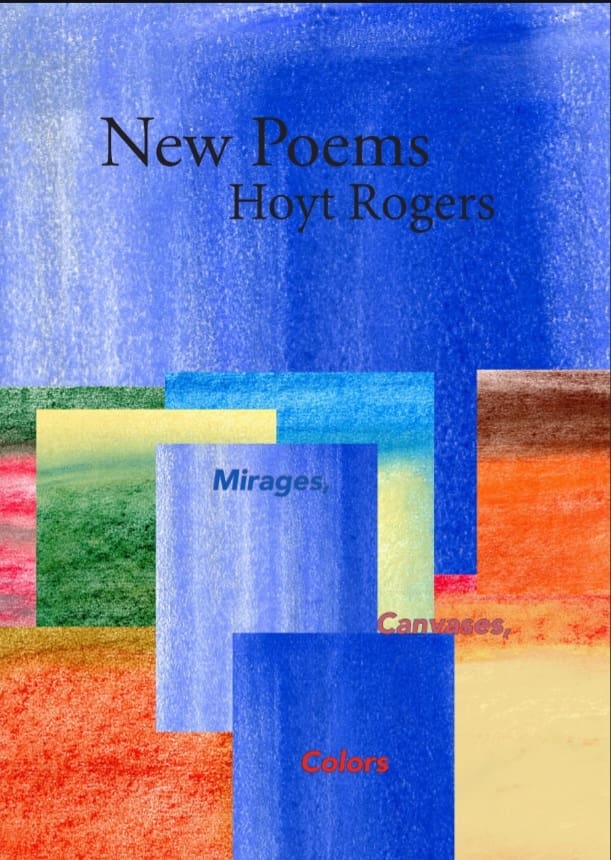
We are pleased to announce the publication by Spuyten Duyvil of Hoyt Rogers’s latest poetry collection, New Poems; virtually all these poems previously appeared in a wide variety of literary reviews. Actually three books in one—Mirages, Canvases, and Colors—New Poems continues his lifelong quest to bring into balance the worlds of nature, words, and the arts. Mirages further explores the island motifs that predominate in his writings; Canvases and Colors pursue the dialogue between the verbal and the visual which is another of his major themes. New Poems is now available from Spuyten Duyvil Publishing, spuytenduyvil.net, Amazon, bookshop.com, and other outlets.
Comments on New Poems
by
Paul B. Roth
Though Hoyt Rogers apparently intended his New Poems to comprise three books—Mirages, Canvases, and Colors—the fact that the first one is divided in turn into three markedly different sections makes the volume seem more like five short sequences, tied together nicely in a readable bundle.
Early on in the book, when he speaks about the shore (p. 35), the opening description is so vivid, so particularized in all its eloquence, that you can almost smell the sea through the words on the page. These three linked pieces, "Shore," "Cavern," and "Moon," are exquisite and inspiring. The simple poem on p. 48, "Window," is beautifully set; it reminds me of a jeweler's intent taking shape in a diamond-studded brooch. In the same section, "The Mayor and Mort" and “Messenger,” with its Zion Trailer Park story, reveal a good sense of humor we find here and there throughout the entire collection.
By the time we reach the sequence called “Narrative Mirages,” we’re mesmerized. Rogers doesn’t disappoint with "Puppets and Marionettes” on p. 84-86, which includes these quotable lines:
People try to separate the arts, but that's a basic fallacy. We're a total theater, a total illusion. The image is itself reality: since we'll never own what we depict, we possess it all the more.
"Your Painting, Your House" in this same section is another poem that appeals to me very much. I love the way Rogers artfully breaks a Poussin painting into many interpretive parts. I wouldn't know where to start, but I’m certain that what he’s done is quite unique—actually, quite amazing.
All of this leads neatly into both the Canvases and the Colors books, my favorites. I marvel at the poet’s ability to paint colors in words across the page. We can feel the poem sketching itself into existence, and because Rogers pays such attention to detail, there's no questioning the authenticity of each of these pieces.
In the case of Canvases especially, I’d like to hear the poems read with my eyes closed, so I could visualize even better the artworks the poet has subtly created. The brevity of the sentences makes them all the more imaginable, because there's no spoilage, no waste, no leftovers. I can see why a wider page-format was needed, so as to keep the precise rectangles of the paintings intact. There's so much more in this volume, in these two divisions, that I could go on and on. Still, another poem that really captivated me was "Jug," in the Colors sequence: a fine example of how to let the image say the unsayable, particularly when the dog's blood ends up as the "wavy red line" on the cooking pot.
One thing that pervades all these little books combined is the author’s ability to weave his own life, even its intimate aspects, into the natural and artistic world as a whole. The autobiographical element doesn't come and go: it stays with us throughout, even when he may assume he’s being totally objective. We can sense him enjoying the life he’s experienced and all that it's offered. But we can also shadow him on dark nights in foreign cities, when he walks back in the rain from a solitary meal, wondering where he is on our earth. Those times of aloneness no doubt helped inform and nurture everything contained in these poems.
— Editor and Publisher of The Bitter Oleander Press, Paul B. Roth is also a well-known poet. His most recent collection is Before the Aftermath.
Comments on previous poetry collections by Hoyt Rogers
On Thresholds:
With this magnificent book, Hoyt Rogers has come of age as a significant writer... He has enriched the language of poets like Oppen, Lowell, and Heller, who would all salute him. —Anthony Rudolf
These oceanic meditations on the vicissitudes of existence—love, transience, the relentless immortality of recurrence—are piercing, hypnotic, and deeply moving. —Jonathan Galassi
In Thresholds, Hoyt Rogers shares a series of poems about impermanence. This collection offers musings on nature, relationships, and endings… Rogers considers how words can salvage hope, but also betray, and how silence can be a language all its own. He explores the fragile, ephemeral nature of love and the tension between connection and distance. He highlights the repetition of life, suggesting that happiness is infinitely renewable in nature and in love… Rogers’ style blends lyricism with philosophical meditation, making this an emotionally intriguing and intellectually stimulating collection. His connection to the natural world is visceral and immersive; he deftly evokes the exhilaration of love… This is an introspective collection that invites contemplation.
—KIRKUS REVIEWS
Hoyt Rogers has crafted a book of paradox and mystery unlike any other I have encountered in quite a few years, each page—each line—a doorway into a world oddly familiar and utterly new. —Daniel Lawless
His highly personal relationship with nature, man-made objects, and the unknown worlds around us brings us closer to ourselves… as if every single thing has lived for the word that’s about to name it. —Paul B. Roth
On Heard in Art:
Heard in Art is an unique book, a meeting of visual stimulus and poetic response that is among the most sensuous acts of “hearing’ I know… I have been stunned and overwhelmed by Hoyt Rogers’ luscious and melancholy investigation of eros and death, his greatest achievement to my mind. —Jonathan Galassi
Poems about paintings broaden and deepen our understanding of their subjects; only the best ones, however, match their visual eloquence: sublimely, Hoyt Rogers' do. —Daniel Lawless
The painting has become the poem, the poem has become the painting, and with deepest thanks to Hoyt Rogers for his keen ear, both are the gift we're given to hear. —Paul B. Roth
Paintings do not speak. They show. Such is the paradox announced right from the title of Hoyt Rogers’s captivating Heard in Art… Through his precise, vivid, indeed sensual poetic language, the very settings and scenery, the objects and finery, the models and their truths or fictions, appear themselves to be asserting their presence. And Titian, Tintoretto, Caravaggio, Claesz, and Vermeer can somehow be heard passing over in their minds how each detail must lead to another and form a visionary whole. Yes, the spectator—the poet, but also the reader—is a “seer” who has learned to listen to “the seen.” This is Baroque illusionary art at its subtlest and often at its most verbally lavish: these poems are miraculously expressive. —John Taylor
On Witnesses:
Every poem is an island, surrounded by the ocean of language; these microcosmic works by Hoyt Rogers map a gleaming archipelago of words. —Pablo Báez
Intermingling poems in verse with poems in prose, Witnesses is a cry of love, suspended in time, with the terror and beauty of youth. The purity of its timbre evokes John Keats, but its vast respiration and bold roaming connect it mysteriously to Walt Whitman. It teaches us to take delight, all over again, in the marvel of utterance. —Anne Davenport
Los poemas de Hoyt Rogers son como hermosos caracoles que recogemos en la playa. Nos enriquecen, nos revitalizan, pero sobre todo nos llenan de poesía, especialmente cuando de noche nos los acercamos al oído y distinguimos su voz mezclada con la del mar. — Frank Báez
The Complete Caribbean Trilogy


‘Rogers’s evocation of its history, its art, and its denizens, captures… the irrepressible invention and intoxication of Caribbean culture. An endlessly immersive and at times awe-inspiring… postmodern epic.’ —Kirkus Reviews
Setting a record, each volume of The Caribbean Trilogy won the Independent Press Award for Hispanic/Latin Fiction. All three books were published by Spuyten Duyvil Press, and are available from https://www.spuytenduyvil.net, Amazon.com, bookshop.org, and other outlets.
Written over a span of twenty-seven years, and now being published in close succession, The Caribbean Trilogy depicts an eccentric cast of characters in a lush tropical setting. Despite her travels throughout the world, Chiara marvels at the island of Canuba, where ‘magic realism is everyday life.’ Presented on a three-level stage, Return to Dawn recounts the eventful lives of the musician and agronomist Alfonso, the devious politician Ángel María, and the ‘failed saint’ Gustavo. In the end, only Chiara and the mysterious mambo Diana find the courage to surmount the darker side of paradise.
WINNER OF THE INDEPENDENT PRESS AWARD FOR HISPANIC/LATIN FICTION
A Commentary on Return to Dawn
by
Ricardo Bernardo
Return to Dawn, the third volume of Hoyt Rogers’s Caribbean Trilogy, brings to an end his epic of Chiara, a Sicilian travel writer who lives in the legendary island of Canuba. This time we get a broad depiction of the country’s politics and society, acted out by many of the locals the protagonist has befriended, and with whom she has weathered the tumultuous turning points of its history. The other three key figures of the story, along with Chiara, are Ángel María, the arriviste political animal, corrupt and self-serving; Diana, the sensual Voodoo priestess, resourceful and strong, committed to the improvement of the Bonaventuran ethnic minority; and Gustavo, an aristocratic sybarite, hedonistic yet mystical, who commits suicide because of his metaphysical disjunction from the world.
The supporting cast includes an agronomist who pursues bird-watching and classical music, influential ladies from the ruling class, rural priests who belong to a delusional Catholic sect, young hustlers trying to get ahead in a dehumanized society, pseudo-artists and dilettantes, unscrupulous lawyers, and simple country folk. Their fascinating tales, full of humor, parody, drama, and pathos, give us a comprehensive view of today’s Spanish Caribbean: the region’s fusion of cultures, its closeness to nature, the warmth and hardness of its people, the fluid approach to sex, gender, and personality, the excesses of sensory pleasures, the greed intrinsic to its social order, the loss of paradise through overdevelopment and commercialism, and the transculturation of embracing the “American way of life.”
This third installment of the trilogy again deploys the stylistic traits we found in the prior two books: the satire of institutions, mainly through the lens of larger-than-life characters, and the “over the top” tempo in which many Canuban events are portrayed. These are mixed with ethereal passages of Chiara’s musings and reflections, as well as an ongoing intertextuality that adds historical, cultural, artistic, and religious references to the tale. This time Rogers uses “vignettes” to tell the story as scenes from our collective memory, in an approximate but not strict chronological order. He frames the narrative as a theater production, without any pretense that it would actually be performed, by way of underlining that life in Canuba is charged with histrionics. The denizens of the island wear many masks, and embody their roles in an exaggerated manner, with a deliberate dose of “camp.” Two of the main characters even devise double personae they inhabit, in the urban context and in the remote countryside: Ángel María/“Osorio” and Diana/“Rebeca.”
Theoretically, the saga’s chapters and Chiara’s soliloquies become the episodes of a play. The three-level “staging” incorporates a variety of theatrical techniques. Among them are bunraku (large silent puppets manipulated by figures dressed in black), marionettes, Sprechstimme recitatives, alternating dialogue and declamation as in a Passion Play, musical accompaniment, and so on, all serving to heighten the twists of the plot. Yet Return to Dawn is a hybrid, post-modern product, both a narration and a drama, a prose work that only hypothetically uses such devices for illustrative effect. Actors occasionally pantomime the events, performing mutely or reciting some dialogue, while others manipulate puppets or marionettes. Still, for the most part we are following a text declaimed by readers at a lectern, a kind of “secular oratorio.” There are three alternating readers, irrespective of the nature of the scene: Male, Female, and Trans, an approach that underscores the trilogy’s theme of pan-sexualism. Queer identity is not set apart from straight identity; the author’s point seems to be that such distinctions are artificial, that they overlap and merge. They also subversively undermine each other, just as fiction and theater run counter to one another in the novel itself.
The first volume of the trilogy, Sailing to Noon, is a paean to nature and human love; the second, Midnight at Sea, is an exaltation of music, painting, and dance. Return to Dawn insistently brings to the forefront the darkest side of Canuba, which mostly remained in the background in the previous two books: personal and political violence, avarice, and perverted values. Chiara is obliged to come to terms with duplicity, cruelty, self-destruction, and even murder. The radiant illusion of Canuba that had bewitched her in the past slips from her grasp, just as the innocence of its people and the unspoiled state of its landscape have ceded to the forces of “progress” and economic development. To cope with this existential crisis, she tries to escape through frantic travel and far-flung spiritual retreats, as well as by compulsively writing about her life on the island, shaping her perspectives on the experience. In one of the final interludes of the purported play that is Return to Dawn, we find Chiara composing in her notebooks the narrative that evolves into the trilogy—and ultimately, the drama we are “watching.”
The bitter cynicism underlying the novel is alleviated at the end, but only after Ángel María, who personifies the malignant political system and the ruling elite, is liquidated by the evils he represents: racial prejudice, transculturation, social oppression, and sexual hypocrisy. His horrifying fate seems like an enactment of the underclass taking revenge on its overlords, in a nocturnal countryside where nature is also revindicated. Freed from his ruthless domination, Diana almost dies in a migrant sea crossing; yet she is infused by this rite of passage with a deeper sense of her mission. As the old power-structures collapse, and the ancient dictator finally breathes his last, she brings advancement to the Bonaventuran community. By setting up a charitable foundation in Miami, she comes to the aid of her compatriots there as well, and expands her scope to embrace the cause of human rights worldwide. In Canuba, she allies herself with Verbena, the young leader of a reformist party that heralds a more enlightened political and societal unity.
As to Chiara, she remains true to the erotic ambiguity of the trilogy as a whole. She becomes a longtime companion to Diana, living with her part-time in Miami. But she also founds a relationship in Canuba with Tino, a mature partner loyal to his campesino and Taino roots; like Diana’s, his stability anchors her emotionally and spiritually, though this doesn’t keep her from continuing her wide-ranging trips for the travel magazines. At the close of the book, Chiara is flying from the southwest coast in a cub plane to Puerto Indio: from above, at dawn, the topography of Canuba looks like “a vision among the clouds.” In her recent stays on the island, she is spending time once more in the few remaining virgin areas, inspired by her love for Tino, an authentic descendant of the original inhabitants. She is now wiser, more at peace—and in this calmer state, Chiara feels like “she’s floating on air.” Rejuvenated, she loops back to where her journey began, starting anew in the magical land of Canuba, her unique island as vivid as a dream.
Even more daring in its narrative design than the first two novels, Return to Dawn provides an innovative and spellbinding conclusion to The Caribbean Trilogy.
- Born in Cuba, raised in Santo Domingo and San Juan, Ricardo Bernardo received a Master's Degree in Spanish Literature from Brown University. He taught Spanish at Brown and in schools in Boston and Washington D.C. before settling in Miami, where he participates in Miami Book Fair International and many other cultural organizations.
Praise for Sailing to Noon, the first volume of The Caribbean Trilogy, winner of the Independent Press Award for Hispanic/Latin Fiction:
‘Rich and multifarious, Sailing to Noon has enormous vitality and texture: it is a big performance—the epic myth of Canuba.’ —Jonathan Galassi
‘I really felt this book: I entered its geography, saw and smelled and moved in it, which is a tribute to its vivid intimacy.’ —Siri Hustvedt
‘You should put this book in a tightly sealed drawer; otherwise, it’s so alive it might run away.’ —Edmund White
Praise for Midnight at Sea, the second volume of The Caribbean Trilogy:
‘Rogers’s evocation of its history, its art, and its denizens, captures… the irrepressible invention and intoxication of Caribbean culture. An endlessly immersive and at times awe-inspiring middle volume of a postmodern epic.’ —Kirkus Reviews
Like the first two volumes, the final volume of the trilogy is now available from Spuyten Duyvil Publishing, spuytenduyvil.net, Amazon, bookshop.com, and other outlets.


Published by MadHat Press, and available directly from the publisher at https://madhat-press.com/products/arion-by-hoyt-rogers, as well as at Amazon, bookshop.org, and other outlets.
We are pleased to announce the publication by MadHat Press of HR's new book Arion: Essays on Literature and the Arts. We are particularly grateful to the publisher, Marc Vincenz, for bringing to fruition this complex project. We also owe a great debt of thanks to the eminent scholars and essayists who kindly endorsed this volume, Terence Cave, Siri Hustvedt, Anne Davenport, and Susanne Wofford.
“In Midnight at Sea (2025), Hoyt Rogers continues his lengthy account of a fictional journalist and her fictional island in the second literary novel of his Caribbean Trilogy, following Sailing to Noon (2023)… Sicilian-born, Princeton-educated journalist Chiara Trigona, the protagonist of Rogers’ previous novel, appears in this one as the addressee of monologues by five people who loved her over the years… Rogers’ novel takes the form of long chapters, each of which moves backward in time by section toward the moment when the speaker first met Chiara… The author renders each voice with such specificity and vivacity that readers will be content to accompany them through whatever territory they wish... Rogers’ evocation of its history, its art, and its denizens captures… the irrepressible invention and intoxication of Caribbean culture. An endlessly immersive and at times awe-inspiring middle volume of a postmodern epic.” Kirkus Reviews
You can access the full review at the Kirkus website:
https://www.kirkusreviews.com/
WINNER OF THE INDEPENDENT PRESS AWARD FOR HISPANIC/LATIN FICTION
All five of the speakers in Midnight at Sea address their accounts to Chiara, who serves as a sixth narrator through her ongoing responses. While Sailing to Noon consists of monologues in the first person, Midnight at Sea tells the story in the second person; eventually, the final volume (Return to Dawn) will dramatize the tale in the third person. The first book of the trilogy, Sailing to Noon (1979-1991) focuses on nature and love as intermingled forms of embodied existence; the second book, Midnight at Sea (1991-2001) takes music, dance, and the visual arts as its leitmotivs; the third book, Return to Dawn (2001 to the present) will concentrate on society and politics, acted out on a three-tiered stage. As in the final pages of Midnight at Sea, bunraku and marionettes will also come into play.
Published by Spuyten Duyvil Press; available from the publisher, Amazon, bookshop.org, and other outlets.

Every poem is an island, surrounded by the ocean of language; these microcosmic works by Hoyt Rogers map a gleaming archipelago of words.
— Pablo Báez
Intermingling poems in verse with poems in prose, Witnesses is a cry of love, suspended in time, with the terror and beauty of youth. The purity of its timbre evokes John Keats, but its vast respiration and bold roaming connect it mysteriously to Walt Whitman. It teaches us to take delight, all over again, in the miracle of utterance. Most saliently, Witnesses plunges us into the strata of human experience that lie hidden in subterranean privacy, emerging only as prayer. Personally, I return to this collection again and again: it is a volume for all seasons.
— Anne Davenport
Los poemas de Hoyt Rogers son como hermosos caracoles que recogemos en la playa. Nos enriquecen, nos revitalizan, pero sobre todo nos llenan de poesía, especialmente cuando de noche nos los acercamos al oído y distinguimos su voz mezclada con la del mar.
— Frank Báez
Published by Spuyten Duyvil Press; available from the publisher, Amazon, bookshop.org, and other outlets.

HEARD IN ART
Ekphrastic Poems on Titian, Tintoretto, Caravaggio, Claesz, and Vermeer
With copious full illustrations and picture details
Comments on Heard in Art:
Heard in Art is an unique book, a meeting of visual stimulus and poetic response that is among the most sensuous acts of “hearing’ I know… I have been stunned and overwhelmed by Hoyt Rogers’ luscious and melancholy investigation of eros and death, his greatest achievement to my mind.
—Jonathan Galassi, Publisher of FSG
Ekphrastic poems broaden and deepen our understanding of their subjects; only the best ones, however, match their visual eloquence. In Hoyt Rogers's marvelous new volume, Heard in Art, time and again, whether addressing works from Titian or Vermeer, Tintoretto, Caravaggio, or Claesz, sublimely, with wild erudition, they do.
—Daniel Lawless, author of I Tell You This Now
After all is said and done, whatever it is we leave behind of ourselves can sometimes be deemed an extraordinary treasure. This exquisite collection of ekphrastic poems—Heard in Art by Hoyt Rogers—based on a favored grouping of paintings by the artists Titian, Tintoretto, Caravaggio, Claesz, and Vermeer, is just that. With great imaginative zeal, Rogers reveals in detail those particulars within each work that might easily go unnoticed but which are fundamentally critical to the balance of each painting. His poems accompany each depicted object and each character by way of an eloquent association of its particulars with his own hopes, dreams, loves, and regrets. By doing so, the artist and the poet have traded places. The painting has become the poem, the poem has become the painting, and with deepest thanks to Hoyt Rogers for his keen ear, both are the gift we're given to hear.
—Paul B. Roth, author of Before the Aftermath
Hoyt Rogers has bravely chosen famous paintings, supreme masterpieces, to explore in his sequence of poems. Bravely but also wisely, because readers fortunate enough to discover the book will bring their own love and knowledge of the pictures to these encounters. The highest praise I can give is my certainty that our mutual mentor, Yves Bonnefoy, would have loved this magnificent volume—not only the poems, but the generous notes as well.
—Anthony Rudolf, author of Silent Conversations and European Hours
Paintings do not speak. They show. Such is the paradox announced right from the title of Hoyt Rogers’s captivating Heard in Art. The poet has carried off the tour de force of listening to painting, that “silent poetry” (as Simonides of Ceos put it). Through his precise, vivid, indeed sensual poetic language, the very settings and scenery, the objects and finery, the models and their truths or fictions, appear themselves to be asserting their presence. And Titian, Tintoretto, Caravaggio, Claesz, and Vermeer can somehow be heard passing over in their minds how each detail must lead to another and form a visionary whole. Yes, the spectator—the poet, but also the reader—is a “seer” who has learned to listen to “the seen.” This is Baroque illusionary art at its subtlest and often at its most verbally lavish: these ekphrastic poems are miraculously expressive.
—John Taylor, author of What Comes from the Night
Published by Spuyten Duyvil Press; available from the publisher, Amazon, bookshop.org, and other outlets.
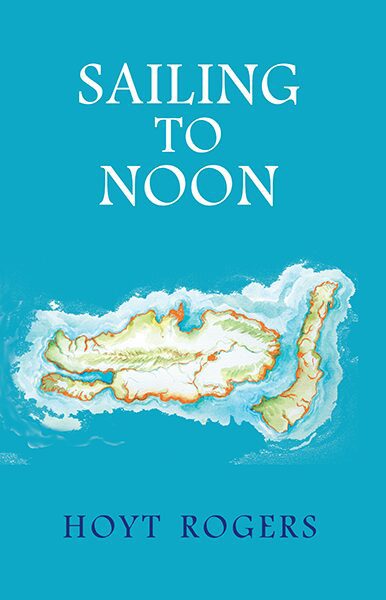
Sailing to Noon
by Hoyt Rogers
In a lush Caribbean setting, Sailing to Noon depicts a colorful range of characters. Despite her travels throughout the world, Chiara marvels at Canuba, where “magic realism” is everyday life. Amado, her pansexual lover, immerses her in its eclectic culture, natural wonders, and buoyant sensuality. Enthralled by her island reverie, she veers off course when disaster strikes: now she must face the darker side of paradise.
Winner of the 2025 Independent Press Award for Hispanic/Latin Fiction, the 2025 IPA Distinguished Favorite Awards for Literary Fiction and for Book Cover Design, and the 2024 NYCBB Distinguished Favorite Award for LGBTQ Fiction
If you missed out on a wild, sexy adolescence or if your friends bore you, read Sailing to Noon. These people—so vital, so different from each other—are the most exciting you’ll ever meet, and Hoyt Rogers holographs them into pulsing existence. Did I mention he’s the world’s greatest ventriloquist and can capture the speech of a Sicilian aristocrat or a Caribbean beefcake or a dozen other dialects? You should put this book in a tightly sealed drawer; otherwise, it’s so alive it might run away.
—Edmund White
By the end of Sailing to Noon, the reader has a strong understanding of the class, color, and sexual divides and overlaps that roil the island with their many historical complexities. I loved the creation myth and the discussion of it at the center of the novel, as well as the beautiful prose given over to what, for lack of a better term, we call “nature writing,” as if we aren’t nature: we are, as Hoyt Rogers underlines. The whale-watching episodes are wondrous. As to Chiara, Amado, Lamia, and their friends, all the characters are deftly drawn throughout. I particularly appreciated Luz Divina, who grows as Chiara slowly penetrates her mysterious form of possessiveness and love—reading the signs. The cat story is brilliant. I really felt this book: I entered its geography, saw and smelled, and moved in it, which is a tribute to its vivid intimacy. But the novel has important dollops of irony and the ludicrous, too, without which it would lose its comedic edge and wisdom.
—Siri Hustvedt
On an expansive canvas, Hoyt Rogers has portrayed a sense of life that is freewheeling and all-forgiving. Rich and multifarious, Sailing to Noon has enormous vitality and texture: it is a big performance—the epic myth of Canuba. I greatly admire the atmospherics, tonal shifts, and drive of this book.
—Jonathan Galassi
Rogers is masterly at building and elaborating upon a community of salty islanders, all set in melodramatic motion or caught in moments of erotic impulsivity. Sailing to Noon benefits greatly from multiple narrators who offer their vibrant perspectives. By the time the rollicking conclusion arrives, it’s evident there are many more tales to tell of this island: Canuba becomes a character in and of itself. Rogers employs satire, sex, and drama in wondrous ways.
—KIRKUS REVIEWS
The Caribbean Trilogy
Though it stands fully on its own, Sailing to Noon is the first volume of The Caribbean Trilogy, three novels by Hoyt Rogers (with guidance from Artemisia Vento and Frank Báez). The second and third books, Midnight at Sea and Return to Dawn are forthcoming; a sequel is also in preparation, The Caribbean Farewell.
Published by Spuyten Duyvil Press; available from the publisher, Amazon, bookshop.org, and other outlets.
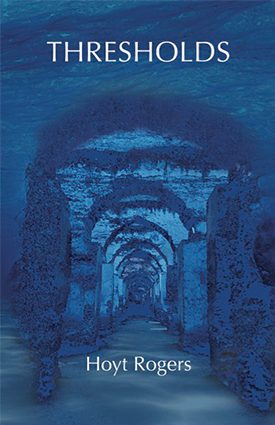
Thresholds
These oceanic meditations on the vicissitudes of existence— love, transience, the relentless immortality of recurrence—are piercing, hypnotic, and deeply moving.
—Jonathan Galassi
Hoyt Rogers has crafted a book of paradox and mystery unlike any other I have encountered in quite a few years, each page— each line—a doorway into a world oddly familiar and utterly new.
—Daniel Lawless
Winner of the 2025 Independent Press Award Distinguished Favorite Award for Poetry
His highly personal relationship with nature, man-made objects, and the unknown worlds around us brings us closer to ourselves ... as if every single thing has lived for the word that’s about to name it.
—Paul Roth
With this magnificent book, Hoyt Rogers has come of age as a significant writer... He has enriched the language of poets like Oppen, Lowell, and Heller, who would all salute him.
—Anthony Rudolf
With precise imagery, the author benevolently recalls those who have crossed his path.... Thresholds chronicles an ongoing quest for what it means to “have a life.”
—John Taylor
In Thresholds, Hoyt Rogers shares a series of poems about impermanence. This collection offers musings on nature, relationships, and endings… Rogers considers how words can salvage hope, but also betray, and how silence can be a language all its own. He explores the fragile, ephemeral nature of love and the tension between connection and distance. He highlights the repetition of life, suggesting that happiness is infinitely renewable in nature and in love… Rogers’s style blends lyricism with philosophical meditation, making this an emotionally intriguing and intellectually stimulating collection. His connection to the natural world is visceral and immersive; he deftly evokes the exhilaration of love… This is an introspective collection that invites contemplation.
—KIRKUS REVIEWS
Published by MadHat Press; available from the publisher, Amazon, bookshop.org, and other outlets.
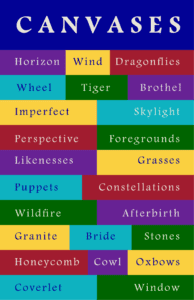
CANVASES
A cycle of prose poems by Hoyt Rogers (Mudlark Press, 2024).
Now available as an online chapbook at
https://mudlark.domains.unf.edu/chaps/mudlark78/rogers-cover.html
OR CLICK ON CHAPBOOK COVER TO ACCESS
A Note on Canvases
These poems are the nucleus of an ongoing sequence of rectangular chunks of “painted prose.” They posit the existence of a non-binary, feminist, multiethnic, environmentalist, Hispanic-Caribbean artist who writes ekphrastic poems about her/his/their own works, and then paints over them. To some degree, the prose poems run parallel to a verse-cycle entitled Colors, which follows a similar pattern of polychrome variations.
Both the prose poems and verse-cycle are connected to passages in my forthcoming novel, Midnight at Sea, the second volume of The Caribbean Trilogy (the first, Sailing to Noon, has already appeared at Spuyten Duyvil Press). One of the main characters is a painter named Virgilio, who thinks in terms of canvases; sometimes he executes his conceptions, but often they remain suspended in his mind.
In addition to his own works, he describes plates from The Taíno Codex, an indigenous manuscript from the sixteenth century. In that apocryphal tome, one of the last Native Americans on a Hispanic-Caribbean island has created a codex similar to the well-known Aztec and Inca accounts.
In all forms—whether verse, prose poetry, or narrative—I’m exploring how an artwork can generate an ekphrastic word-scape, only to pivot back towards the visual once again. —HR
WILL:
Shakespearian Sonnets
by Marco Simonelli
translated and introduced by Hoyt Rogers
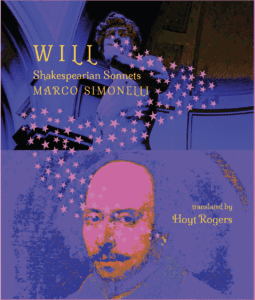
Shakespeare’s sonnets, transposed to contemporary Florence…
Marco Simonelli was born in Florence, where he lives to this day; though still in his forties, he has already published a dozen books of verse. His work has figured widely in periodicals, anthologies, and literary festivals; it has been translated into English, French, and German. Some of his titles—Good Manners (2018), Splatter Love Poems (2015), and The Lobster’s Complaint (also 2015)—reveal the mordant wit for which he is known. But this does not preclude a serious vein, poignantly felt in one of his most recent books, Anxious Litany: a subtle analysis of depression, the work draws on such classic authors as Tasso, Leopardi, and Pascoli.
Far more light-heartedly, Simonelli’s Will: 24 Sonnets (2009) pays homage to Shakespeare’s sonnets, giving them a modern Tuscan twist. As he points out in his brief prologue, the English poet often makes a pun on his own nickname, “Will” (for example, in sonnets 135 and 136). The word implies many meanings, from strong determination to Elizabethan slang for the male organ, and from lustiness in general to a formal legal testament. But Simonelli underlines a connotation that would not immediately occur to an English-speaker: the ubiquitous role of “will” as an auxiliary verb in the future tense—that horizon of uncertainty which leaves us all in a state of flux.
“Poetry that wins your heart…”
— Lello Voce
“The problem is always the soul’s salvation; the solution, here and now, is the sublime reality of a same-sex love that’s tenderly revealed.
— Rosaria Lo Russo
"These sonnets are an erotic and ironic marvel! The Bard would have loved them.”
— Elisa Biagini
Published by Spuyten Duyvil Press; available from the publisher, Amazon, bookshop.org, and other outlets.
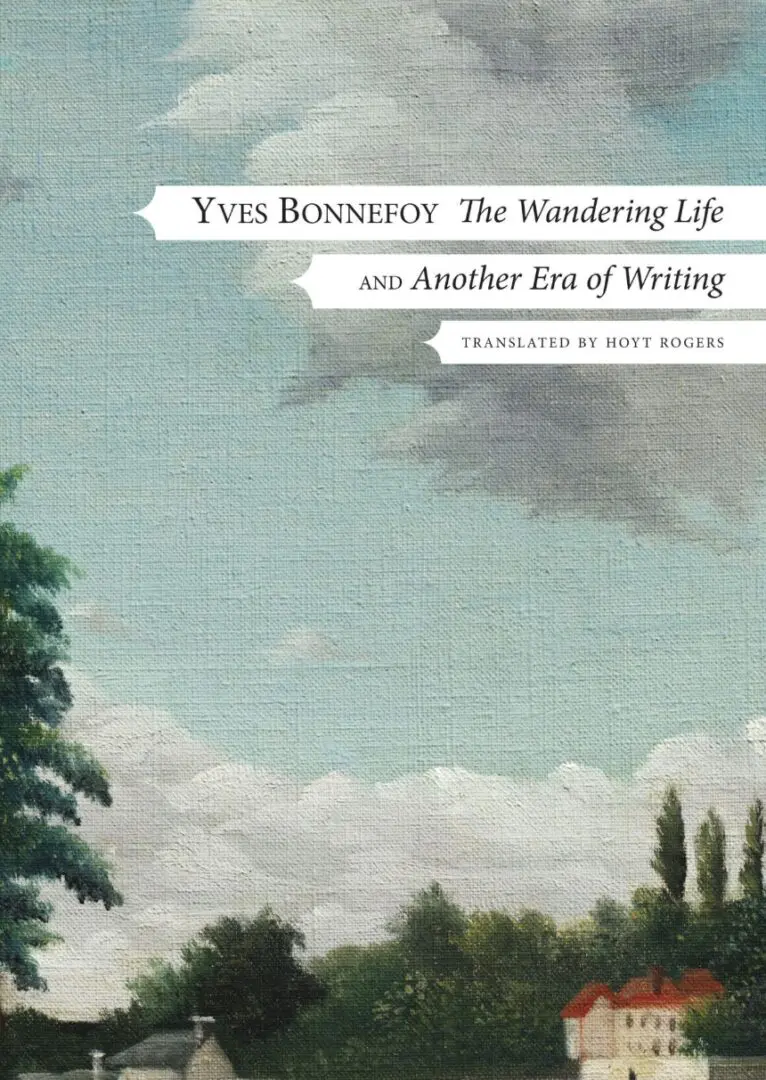
YVES BONNEFOY:
THE WANDERING LIFE
and ANOTHER ERA OF WRITING
Translated and with an afterword by Hoyt Rogers
‘Bonnefoy is well known for obscuring the boundaries between verse and prose, just as he often confronts the representational issues that both vex and liberate the so-called sister arts of poetry and visual art.’
—World Literature Today
Yves Bonnefoy was an ardent voyager throughout his life. His constant journeys and sojourns abroad, from Italy and England to America and India, left an indelible mark on his oeuvre. Tellingly, he entitled one of his major books La Vie errante (1993). The Wandering Life now appears in translation for the first time to celebrate the centenary of the author’s birth. Central to his development, this work crystallizes the traveler motif as a metaphor for aesthetic exploration. It also found a new poetic technique: that symphonic interweaving of verse and prose, which characterizes the final twenty years of his creation. In a shorter but equally important companion piece, Another Era of Writing, Bonnefoy reframes the voyage as a philosophical quest, a far-reaching dialogue between language and reality.
Yves Bonnefoy (1923–2016) was one of France’s greatest poets. He received many international awards for his work. In addition to poetry and literary criticism, he published books on art history and translated over a dozen plays by Shakespeare. In 2023, the centenary of his birth, his writings appeared in the prestigious Pléiade series of French authors.
Hoyt Rogers is the author of a poetry collection, Thresholds (2023), and a study of Renaissance verse, The Poetics of Inconstancy (1998). He has published five translations of works by Yves Bonnefoy, including Rome, 1630: The Horizon of the Early Baroque (Seagull Books), which won the 2021 French-American Foundation Translation Prize for Nonfiction.
Published by Seagull Books/U of Chicago Press; available from the publisher, Amazon, bookshop.org, and other outlets.
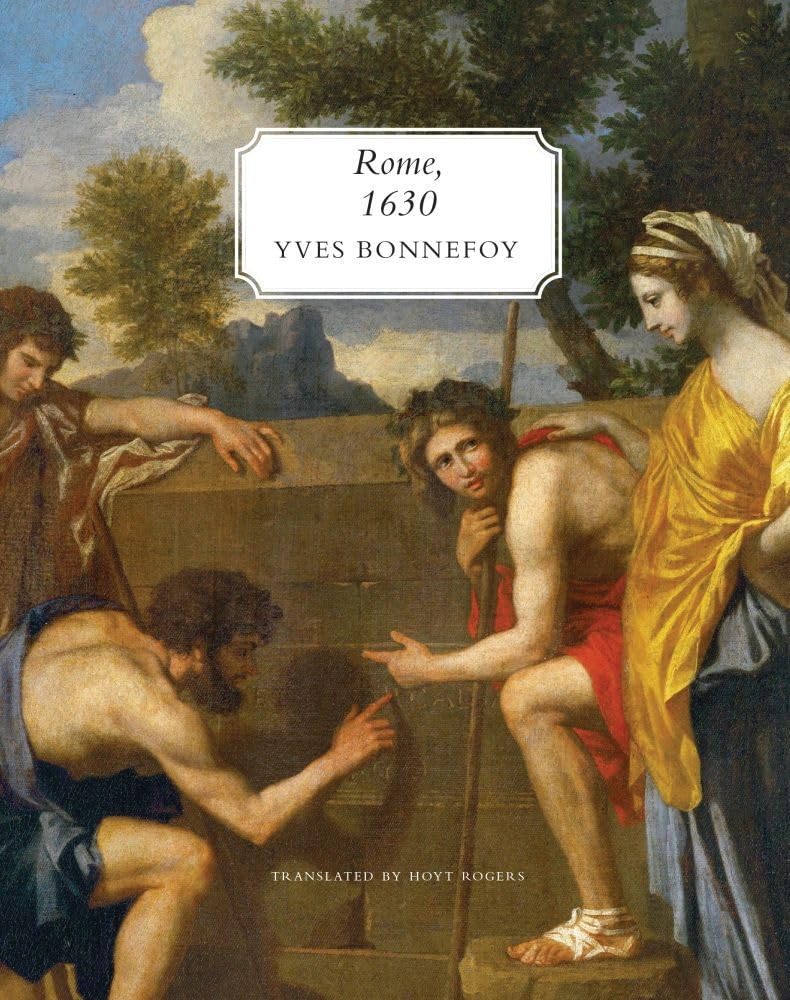
YVES BONNEFOY, ROME, 1630: THE HORIZON OF THE EARLY BAROQUE, followed by FIVE ESSAYS ON SEVENTEENTH-CENTURY ART; Edited, Translated, and with an Afterword by Hoyt Rogers
Winner of the 2021 French-American Foundation Prize for Translation (Nonfiction)
'In the title study of this book, Yves Bonnefoy focuses on a pivotal year in the development of the Baroque style. Richly illustrated, his Rome, 1630 reveals how a pan-European movement was born from the achievements of the Italian and foreign artists who congregated in the city during that seminal period. The five supplementary essays in the volume further explore the evolution of seventeenth-century painting, particularly in the works of Elsheimer, Caravaggio, Corona, and Poussin. In his afterword, Hoyt Rogers
pays homage to the author himself, analyzing the centrality of Baroque art to Bonnefoy's poetry and aesthetics.'
—Seagull Books
'Yves Bonnefoy's Rome, 1630 is a marvel and a triumph, in this lucid English version by Hoyt Rogers. Together with the five further essays on seventeenth-century art that accompany the main text, this work complements the aesthetic meditation of The Arrière-Pays, which I translated for Seagull some years ago. In that book, Bonnefoy concentrates on the Italian Renaissance, whereas here, he focuses on the Roman Baroque. Along the way, he pays particular attention to two foreigners who were active in the Eternal City: Adam Elsheimer and Nicolas Poussin. In his wide-ranging afterword, Rogers discusses the poet's lifelong fascination with both painters. This is a beautiful volume of fine quality and pleasantly compact despite its length; rarely has an art book been so comfortable to read. I have re-entered with joy that great "hustle and bustle at St Peter's" in 1630.'
— Stephen Romer, Oxford University, Bonnefoy translator
'I love Hoyt Rogers's afterword to Bonnefoy's remarkable study. It is very personal, freewheeling, and learnèd; the translator is released from bondage to the text. As to the original, it is Yves Bonnefoy at his most recondite and complex and requires a devoted servant, if not the slave implied by my word "bondage." I, too, am one of Bonnefoy's several devoted servants around the world, and I salute Rogers's translation of this book. As readers, writers, and translators, we were and remain inspired by Yves Bonnefoy, poet, writer on art and literature, teacher, and friend.'
– Anthony Rudolf, author, publisher, and Bonnefoy translator
'Rome, 1630 is an important meditation on art history and, above all, on the philosophy of art. The long friendship between the author, Yves Bonnefoy, and his translator, Hoyt Rogers, was extremely fruitful for both of them. When they met in Paris, the poet was writing his extensive book on the Italian Baroque, first published in 1970. Fifty years later, this outstanding translation by Rogers, combined with that of five further essays by Bonnefoy on the same subject, affords the English-speaking world insights into the very personal "intensity of gaze" of the French author. In his afterword, "Ut poesis pictura," Rogers takes the reader on a brilliantly written journey through the "cross-fertilization" of art and poetry in Bonnefoy's work.'
— Cornelia Kemp, art historian, Research Institute of the German Museum
'In 1630, Rome witnessed a breakthrough in art, an advance that intertwined with social, economic, philosophical, and scientific developments. This turning point changed Western civilization forever. Yves Bonnefoy accompanies us in exploring this shift, leading us on a poetic journey through the history of art. Not only is the translation by Hoyt Rogers masterly, recapturing the essential poetic vigor of the author, but the illustrations are also exceptional. In his afterword to the book, Rogers gives the reader an interpretative key to Bonnefoy's work that grants us an intimate and familiar vision of the author. With this addition, the volume becomes a conversation like the many Bonnefoy and Rogers exchanged over the course of their friendship. And this time, we are more than happy to participate.'
— Michele Casagrande, arts administrator, Milan
Published by Seagull Books/U of Chicago Press; available from the publisher, Amazon, bookshop.org, and other outlets.
(Click above to continue to next page)